The Man Who Wrote Down His Secret
Most successful investors guard their edge carefully. They build proprietary models, hire quants, and work hard to stay ahead of competition. Joel Greenblatt did the opposite.
He wrote a short, plain-language book explaining precisely how he thinks about investing — and then aimed it at high school students. Not because the strategy was worthless, but because he understood something important: knowing a strategy and actually following it are entirely different problems.
From Law School to Wall Street
Joel Greenblatt was born in 1957 and grew up in Great Neck, New York. He attended the University of Pennsylvania's Wharton School, graduating with a degree in finance, and later received his JD from Stanford Law School.
Despite his law degree, Greenblatt never practiced law. His interest in investing had crystallised early — he was particularly drawn to the work of Benjamin Graham, the Columbia professor who codified value investing and mentored Warren Buffett.
In 1985, at the age of 27, Greenblatt founded Gotham Capital with approximately $7 million in seed capital. He was given unusual autonomy: a small fund, a simple mandate, and the freedom to invest however he saw fit. What followed was extraordinary.
Gotham Capital: The Track Record
Between 1985 and 1994, Gotham Capital generated a net annualised return of approximately 40% per year. To put that in context:
- Warren Buffett's Berkshire Hathaway has returned approximately 20% annually over several decades — considered the gold standard of long-term investing
- The S&P 500 returns roughly 10% annually over the long run
- The average actively managed fund barely keeps pace with its benchmark
Greenblatt's 40% annual return over nearly a decade is one of the highest sustained performance records ever documented for an institutional investor. A $1 million investment at the start of that period would have grown to approximately $50 million by the end.
In 1994, Greenblatt returned all outside capital to investors and continued managing only his own money — reportedly because the fund had grown large enough that certain opportunities were no longer accessible at scale.
The Philosophy Behind the Performance
Greenblatt's approach was never about complex financial engineering. It was rooted in a straightforward insight from Benjamin Graham: the market periodically misprices good businesses, and patient investors can profit by buying those mispricings systematically.
His earliest investments were concentrated and unconventional. He looked for companies in special situations — spinoffs, restructurings, bankruptcies — where institutional complexity caused the market to temporarily misprice assets.
But over time, Greenblatt sought to distil his thinking into something more teachable — a framework that captured the essence of good investing without requiring constant analysis of special situations. The result was the Magic Formula.
The Magic Formula: The Distilled Version of His Thinking
The Magic Formula reduces Greenblatt's investment philosophy to its two most important dimensions:
Quality: A company's ability to generate strong returns on the capital it employs (Return on Capital)
Value: The price you're paying for that company relative to its earnings (Earnings Yield)
By ranking every stock in the market simultaneously on both dimensions and selecting the top-ranked companies, the formula systematically identifies businesses that are both good and cheap — the combination Greenblatt had spent his career seeking.
Every stock in a defined universe receives two rankings: a quality rank based on Return on Capital, and a value rank based on Earnings Yield. The two ranks are added together. Stocks with the lowest combined score — meaning they rank highly on both quality and value — are the Magic Formula selections.
This is elegant in its simplicity. It doesn't require predicting the future. It doesn't rely on analyst forecasts. It works with audited financial data that anyone can access.
New to the formula? Our 5-minute explainer of Magic Formula investing covers the essentials without any financial jargon. For a deeper look at the metrics themselves, see What Is Earnings Yield and Return on Capital?
Why Greenblatt Shared It Publicly
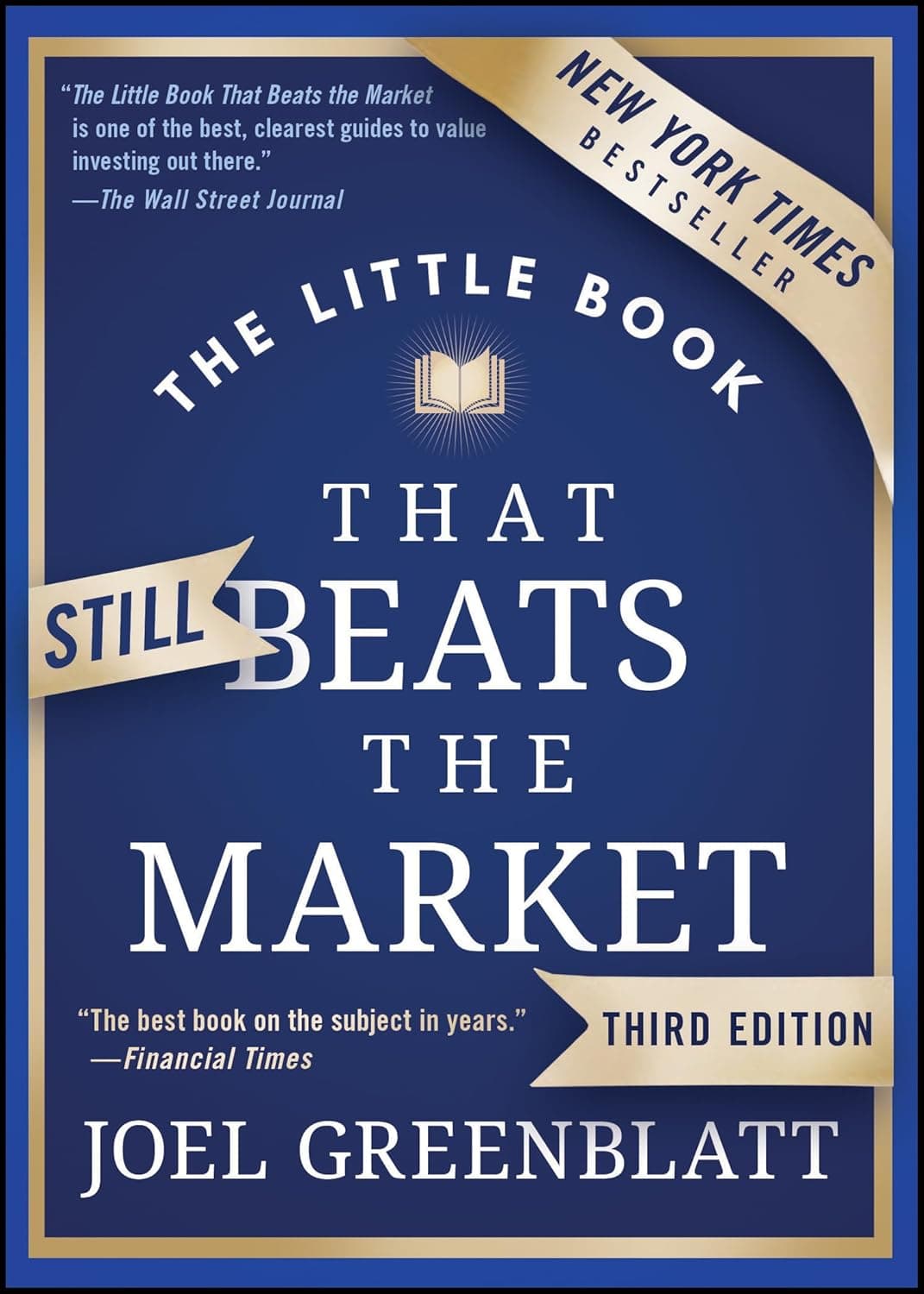
In 2005, Greenblatt published The Little Book That Beats the Market (updated in 2010 as The Little Book That Still Beats the Market). The book was written in accessible language, with minimal jargon, deliberately targeting investors with no financial background.
Why give away a working strategy? Greenblatt's answer was essentially: the strategy works because of human psychology, not because of information asymmetry. Most investors cannot follow a systematic strategy through extended periods of underperformance. They deviate, panic, second-guess, and ultimately abandon the approach precisely when it is about to work best.
Sharing the formula publicly doesn't destroy the edge — the edge is in the discipline to follow it, not in the knowledge of what it is.
This psychological dimension is crucial. We wrote a dedicated piece on why simple beats smart in investing — and why even high-IQ investors struggle with mechanical strategies.
Greenblatt Today: Gotham Asset Management
After returning outside capital in 1994, Greenblatt spent years managing his own portfolio and teaching at Columbia Business School, where he eventually became an adjunct professor.
In 2009, he co-founded Gotham Asset Management with Robert Goldstein, a long-time collaborator. The firm manages money for institutional clients and implements systematic value strategies — more sophisticated versions of the Magic Formula principles, applied across long/short portfolios.
Greenblatt remains active both as an investor and educator. He continues to teach at Columbia and has spoken extensively about the intersection of value investing, market psychology, and systematic approaches to portfolio management.
What Makes His Formula Different From Other Quant Strategies
Transparency. The entire formula is publicly disclosed. There are no hidden adjustments, secret data sources, or proprietary modifications.
Simplicity. Two variables. A single ranking. A straightforward annual rebalancing process.
Theoretical grounding. The formula isn't a statistical artefact discovered by data mining. It reflects a coherent investment philosophy with a logical explanation for why it should work.
Accessibility. Any individual investor with a standard brokerage account can implement the strategy using publicly available screeners and audited financial data.
The Bottom Line
Joel Greenblatt's Magic Formula is not a shortcut or a trick. It is the distilled output of a career spent thinking carefully about what makes investments genuinely good and genuinely cheap.
The fact that a man who made $50 million applying these principles chose to write them down in plain language for ordinary investors is, by itself, a remarkable thing. Whether or not you implement the strategy, the framework it provides for thinking about quality and value in investing is worth understanding deeply.